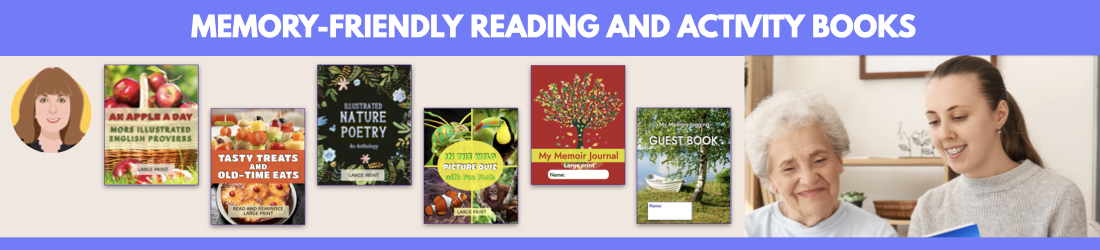
Unforgettable Notes books on display

Dementia-friendly books at the library

Dementia-friendly books

It was such a nice experience to walk into my (redesigned and refurbished) local library and see two Unforgettable Notes books facing out on the Large Print display. The whole library has now got masses of face-out display, which I love. I totally judge a book by its cover!

I know it must be hard for libraries to work out how to shelve dementia-friendly books, especially since the books never mention dementia. I’ve seen them in Health, in Social Sciences, or put into (or displayed nearby) the Memory Care kits. I’ve heard librarians wonder if they should shelve them with Adult Literacy easy-read books. I think that visibility is the key, especially with books displayed at eye level, so this Large Print option is a good one.

I’m also not sure how families manage this situation, if they’re visiting the library with a loved one living with brain changes? How do you make this work for you, if you are one of those family members or friends? I’m guessing you ask in advance, and then wander towards the right section?

There’s a great article here from Forward with Dementia on dementia-friendly libraries and the value of shared reading groups: https://forwardwithdementia.au/news/libraries-and-people-with-dementia/ Thank you, libraries, for providing a place where everyone feels welcome and everyone can find something they’d love to read!

Covers of hardcover visitor books for dementia patients and eldercare

New: hardcover visitor books!

Dementia-friendly books

I know from the memoir books that some people prefer a hardcover book as more durable, and I wondered whether that might be true for visitor and guest books as well? Yes, it has taken me a while to get this happening, but at last I have the books uploaded, and ready to go! So these are hardcover versions of the most popular visitor books…

What are these visitor and guest books about?

They’re not just a ‘name and date’ entry. The whole point is for visitors to make it clear who they are (old colleague, grandson?), write a few lines about the visit, and key things they talked about, say if they brought anything or took anything away, then finally leave any special messages or the date of the next visit. You can see what I mean in this example:

Who are they for?

I call the visitor and guest books ‘dementia-friendly’, but that’s not the only use. They’re for anyone in residential care or at home, who is likely to have visitors, but might have problems remembering who came, what they talked about, or what they brought.

So this might mean someone living with brain changes, but also someone recovering from surgery, or from a stroke, or taking meds that make them sleepy, or living with disability or chronic conditions that affect concentration. The visitor can write in the book themselves, or the book owner can do their own writing after the visitor disappears.

Benefits of a visitor book

I love getting feedback on these books, because the reviews always talk about the pleasure a loved one has in re-reading the entries and reliving the delight of the visits.

It’s also such a relief for care partners to know who has visited, to know who left the grapes and where the photo album has gone (when someone has taken it to scan to digital). My dear mum often had a hard time recalling who had left the flowers in her room. I was so lucky that my dad could keep track, but that’s not the case for everyone.

Practical details

The interiors are the same, but the books are slightly bigger in size than the original soft cover books. That’s because the closest hardcover size available is 8.25 x 11. (Soft cover guest books are 8 x 10 and visitor books are 8.5 x 8.5.)

The new hardback books are available in the UK and in the US, but alas not yet in Australia (unless you pay massive postal charges). I’ve created the most popular two cover styles for each book, to cater for different tastes, and I hope they are useful to someone, somewhere!

Dementia-friendly book covers: Illustrated Bird Poetry, Illustrated Animal Poetry from Unforgettable Notes (Clare P Harris)

Illustrated animal and bird poetry!

Dementia-friendly books

I know, I know – I already have so many large print illustrated poetry books!

I had found some lovely bird and animal poems that I wanted to share, though, so here we are.

Choosing dementia-friendly poems

Sometimes people ask, “Why aren’t all the poems by really famous poets like Keats or Byron?” – but that’s not always easy, especially with animal poems.

Yes, many great poets have written about their pet cat or dog – but as a memorial to a deceased pet. Or reflecting on a wounded deer… While these poems may be beautiful, they could cause sadness or confusion in a reader living with brain changes, so I have chosen cheerful poems, sometimes by less well-known poets.

For example, I have to confess I didn’t really know the work of Herbert Asquith (not the long-ago UK Prime Minister, but his son). Yet I just love ‘The Hairy Dog’ – so simple and charming! I hope your loved ones will also enjoy these poems…

The Hairy Dog (Herbert Asquith)

My dog’s so furry I’ve not seen
His face for years and years;
His eyes are buried out of sight,
I only guess his ears.

When people ask me for his breed,
I do not know or care;
He has the beauty of them all
Hidden beneath his hair.

Here are some sample pages so you can see the layout of the books…

Shared reading

All the books are slim and light, for a ‘just-enough’ reading experience for poetry lovers living with exhaustion, mild cognitive loss, or recovering from stroke.

Some people will be delighted to read alone, but others will enjoy shared reading. Many studies show great benefits from reading together. You provide a supportive voice, so your loved one can read along with more confidence. This is especially important when brain changes have made reading more challenging.

The bonus: sharing your thoughts about the picture or the poem (or about life) can inspire wonderful discussions!

You may find the books at your local library, and you’ll certainly find them on Amazon:

Illustrated Bird Poetry: ISBN 9781922191854. Universal Amazon link: https://mybook.to/BirdPoetry

Illustrated Animal Poetry: ISBN 9781922191861. Universal Amazon link: https://mybook.to/AnimalPoetry

Georgia Efford with dementia-friendly book, A Garden in Gooseberry Hill (Unforgettable Notes, with Clare P Harris)

A Garden in Gooseberry Hill and the Uthando Project

Dementia-friendly books

There’s a lovely photo of Georgia in the Perth Hills local newspaper, The Echo. She’s sitting in her garden with a copy of A Garden in Gooseberry Hill in her hands! I am so thrilled with this book.

Not everyone knows about the Uthando Project, which is where all proceeds from the sale of this book will be directed. Georgia received an OAM for her humanitarian work with the project, which supports vulnerable children in KwaZulu Natal, South Africa, and also offers a great sense of purpose and connection to the many doll-makers here in Australia and around the world. They make culturally appropriate dolls full of life and personality, and also support local doll-making in South Africa.

I have visited our wonderful partner agencies in South Africa, where the impact of the HIV/AIDS pandemic has brought loss and trauma to many children. We ran doll-making workshops for Zulu grandmothers who are now caring for their grandchildren, workshops which promote the healing and connecting value of play. It was such a joy to work with those amazing women and with our partner teams.

Do take a look at the website: uthandoproject.org. If you’re a doll-maker, you can find patterns there. If you’d like to support in other ways – well, one of those ways is through this book!

Picture of Uthando Project dolls and book A Garden in Gooseberry Hill

An update for the hospice visitor books

Dementia-friendly books
Covers of hospice visitor books

I have some updated covers for the Thinking of You hospice-friendly visitor books! I wanted something a little more vibrant, to stand out on a bedside table or coverlet.

These visitor books are like the Get Well Visitor books, but without the Get Well wording. They can be used as standard hospital visitor books, but also for palliative care, chronic illness, or a difficult diagnosis.

For anyone in this situation, all the profound good wishes in the world to you. I hope you are constantly reminded of how much people love and value you.

And if you are visiting someone in hospice, and wonder what you’ll say, here’s a lovely article from the Cancer Council of Victoria. And do remember that when someone seems unresponsive, they may be too tired to open their eyes, but still be able to hear. So always speak to them, never about them. It’s a beautiful opportunity to talk about what they have meant to you, or to revisit great times you’ve shared.

Find out more about these books on the Thinking of You page.

Dementia Australia Library

Dementia-friendly books

Are you in Australia? Did you know that Dementia Australia has a fantastic library? It’s like a free public library, but all the titles relate to dementia. It’s the largest publicly accessible dementia library in the world!

You can browse and have instant access to e-books and audio books. There’s also the opportunity to ask to borrow hard copy titles.

I counted 66 headings in the Topic Guide, like Living with a Recent Diagnosis, Eye Health and Dementia, Long Distance Caring … but of course I’m interested in Reading: Sharing the Experience.

I just borrowed Anne Vize’s Reading in the Moment: Activities and Stories to share with Adults with Dementia. I’d read it before, but wanted the opportunity to look again at the research into bibliotherapy and the suggested readings.

There are also dementia-friendly books (like the ones I write, and including some of mine). Libraries are always a great source of support, but this one is so dementia-specific, and you can email them if you need help to locate something.

Please pass this information on to anyone that doesn’t yet know about it. If they search for Dementia Australia Library, it should be the first result!

A Garden in Gooseberry Hill

Dementia-friendly books

My original name for this memory-friendly book was ‘Georgia’s Garden’, celebrating the amazing artist and keen gardener, Georgia Efford. I know her through her work with the Uthando Project grassroots charity group (for which she got an Order of Australia). Every time I went to meetings at her house in the Perth Hills, here in Western Australia, I found myself wandering outside, admiring her garden.

So when I thought about creating a book on gardening, Georgia came to mind. Would she say yes? Yes, she would!

Gardens are so different in different places, so how do you create a book that everyone can relate to? We decided that Georgia would offer her reflections on her garden and gardening, paired with her own evocative photos, and matched with questions asking the reader to think about their own gardening experience.

This is the first in a ‘Read and Chat’ series, where I hope to feature other ‘real-life’ stories with questions to chat about. Feedback so far has called this a ‘happy’ book, and that’s really what we wanted to achieve. You can see the amount of text in the picture above…just three paragraphs of extra large print per page, and each spread is a new topic.

Profits from sales will go to the Uthando Project, on Georgia’s request.

Here’s a link to the book for Amazon Australia, and also a universal link: https://mybook.to/GooseberryHillGarden

The Perfect Pie dementia-friendly short stories by Cathy Emma Laybourn cover of book

The Perfect Pie: Memory-friendly short stories

Dementia-friendly books

I promised I’d write some dementia-friendly fiction, but I haven’t quite got there yet. However, my lovely sister Emma writes magazine short stories and children’s books (amongst other things!) and has always encouraged me in my memory-friendly writing. So a while ago, I asked if she would consider writing some short stories adapted for mild cognitive loss.

As I’m sure you know, people living with early brain changes often find that while they can still read, they get confused as they turn the page… Who am I reading about? What’s going on? They may still want to read a story with a plot (rather than description only), but they need a little unobtrusive support to stay with the story.

Now here’s the result of Emma’s work! Two collections of large print, ‘feel-good’ stories of everyday life, the kind you’d find in a magazine. However, each new spread has a small reminder at the top of the page of who the characters are and what the story is about. Then as you read down the page, there are more small, subtle reminders of what’s happening. Here’s an example from The Perfect Pie and other stories (by Cathy Emma Laybourn).

First page of dementia-friendly story, The Perfect Pie
Second and third page of dementia-friendly story, The Perfect Pie. We see how the subtle repeats support memory.

These memory-friendly stories feature relatable situations, for example:

The Perfect Pie – Brian has promised to cook a meal for his friend Larry. But Larry keeps changing his mind about his favourite food! What can Brian do?
The Beach Hunt – Moira and her grand-daughter Sophie are enjoying a day on the beach, when Sophie loses a shell bracelet. However, Moira has a solution.
The Lost List – Alec arrives at the supermarket without his shopping list. But thanks to his helpful nature, he ends up with a few new friends as well as all his shopping.
A Change of Garden – Jean is moving to a new flat. Although she’s looking forward to it, she will miss her garden, and especially its bird life. But her son has a surprise waiting at her new home.

Friends and family always feature, as Emma herself says:

When writing for various magazines, no matter what type of stories I wrote, the importance of friendships and family was always central – and that’s true of these stories as well.

She lives in the UK, so there are a few references to money as ‘pounds’ or to ‘thrushes and greenfinches’ in the garden, but the story themes are universal, featuring the challenges and successes of life, with a feel-good ending:

I’ve used simplified, linear storylines and straightforward but not childish language, as well as plenty of memory prompts within the story. I tried to avoid depicting the characters as elderly (although there are a couple of stories about grand-parents and their children) because not all people with memory loss are elderly, and not all elderly people think of themselves as old!

If you’d like to take a proper look, here are the links to The Perfect Pie and other stories and A Robin in the House and other stories. These are universal links to the Amazon store in your country.

All very exciting – and hopefully inspiring to me to do some of my own memory-friendly fiction writing … thanks, Emma!

Welcome to my ‘dementia-friendly books’ site!

Dementia-friendly books

Hello! I’m Clare Harris from Unforgettable Notes (Memory-friendly books). Thanks for finding me!

Up until now, I’ve been using a page on my ESL/Adult Education site, The Book Next Door, to show the world my memory-friendly books, but now they need their own site, and this is it! It’s a work in progress, so bear with me…

If you’re interested in my books, there’s a link to each one in the menu bar above. You can also find all my books on the Amazon site for your country. Here’s a universal link: https://mybook.to/UnforgettableNotes

As for this blog, well, I’ll be posting about my books, about other dementia-friendly books I find, and about new research on dementia and reading.